
Trench Cover Load Classes: B125 to F900
EN 124 defines test-load classes for qualifying complete cover assemblies. The class number is not a vehicle-tonnage rating and does not automatically select a steel-grating model; this guide explains the data needed for a defensible specification.
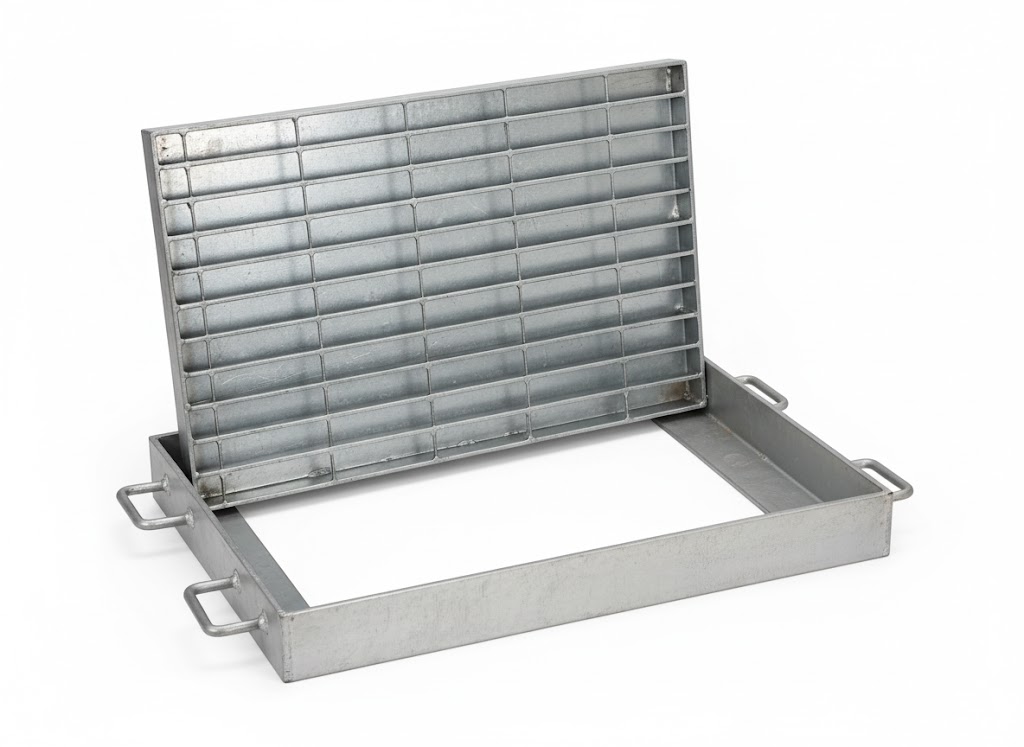
What the EN 124 class number means
EN 124 is written for complete manhole-top and gully-top assemblies within its stated scope. The class number corresponds to a laboratory test load. It is not the permitted vehicle mass, axle load or wheel load, and it does not by itself select a steel-grating bearing bar.
| Class | Test load | Installation group summary | Engineering consequence |
|---|---|---|---|
| A15 | 15 kN | Areas used only by pedestrians and pedal cyclists | Verify the complete assembly where the standard applies |
| B125 | 125 kN | Footways, pedestrian areas and comparable car parks | No universal grating or angle-frame size is defined |
| C250 | 250 kN | Kerbside channel/gutter locations defined by the standard | Location and assembly verification control |
| D400 | 400 kN | Road carriageways and comparable vehicle areas | Do not convert 400 kN to “40-tonne axle” |
| E600 | 600 kN | Areas imposing high wheel loads, such as docks or aircraft pavements | Specialist frame, restraint and foundation coordination |
| F900 | 900 kN | Areas imposing particularly high wheel loads, such as aircraft pavements | Project-specific assembly design and verification |
Important: the standard text and contract documents govern the exact installation groups and test procedure. This table is a procurement summary, not a design approval.
Why a class does not select one grating model
A steel-grating panel transfers load through its bearing bars into the support seat and frame. Capacity changes with bearing-bar depth and thickness, pitch, clear span, load footprint, material strength, banding, restraint and deflection limit. The frame, anchors and surrounding concrete or steelwork must transfer the same load. A fixed statement such as “D400 = G405/40/100” is therefore incomplete unless a tested or calculated assembly and its boundary conditions are identified.
Inputs required for a vehicle-duty cover
- Governing basis: contract standard, local code and whether EN 124 applies to this complete assembly.
- Traffic data: vehicle type, maximum wheel and axle loads, tire/contact footprint, speed, braking, turning and impact conditions.
- Geometry: clear opening, bearing direction, support-seat width, frame/foundation arrangement and allowable panel size/weight.
- Performance: strength, deflection, fatigue where relevant, slip resistance, drainage and corrosion exposure.
- Interfaces: frame, intermediate supports, restraints, locking, lifting points, anchors and concrete edge distances.
Using regional standards without false equivalence
EN 124, AASHTO load models, AS 3996 and local municipal specifications use different scopes, test methods and load definitions. Do not cross-label them as “equivalent” from the class number alone. State the governing document and service condition, then verify the assembly to that basis.
What to write in the RFQ
Send the trench layout, clear openings, traffic/load data, support and frame details, material/finish, locking and handling requirements, destination and governing standard. If the project names an EN 124 class, also state where and how the complete assembly must be verified.